
Remy Hair vs. Non-Remy Hair

Remy Hair vs. Non-Remy Hair

A Detailed Comparison Guide

Summary:

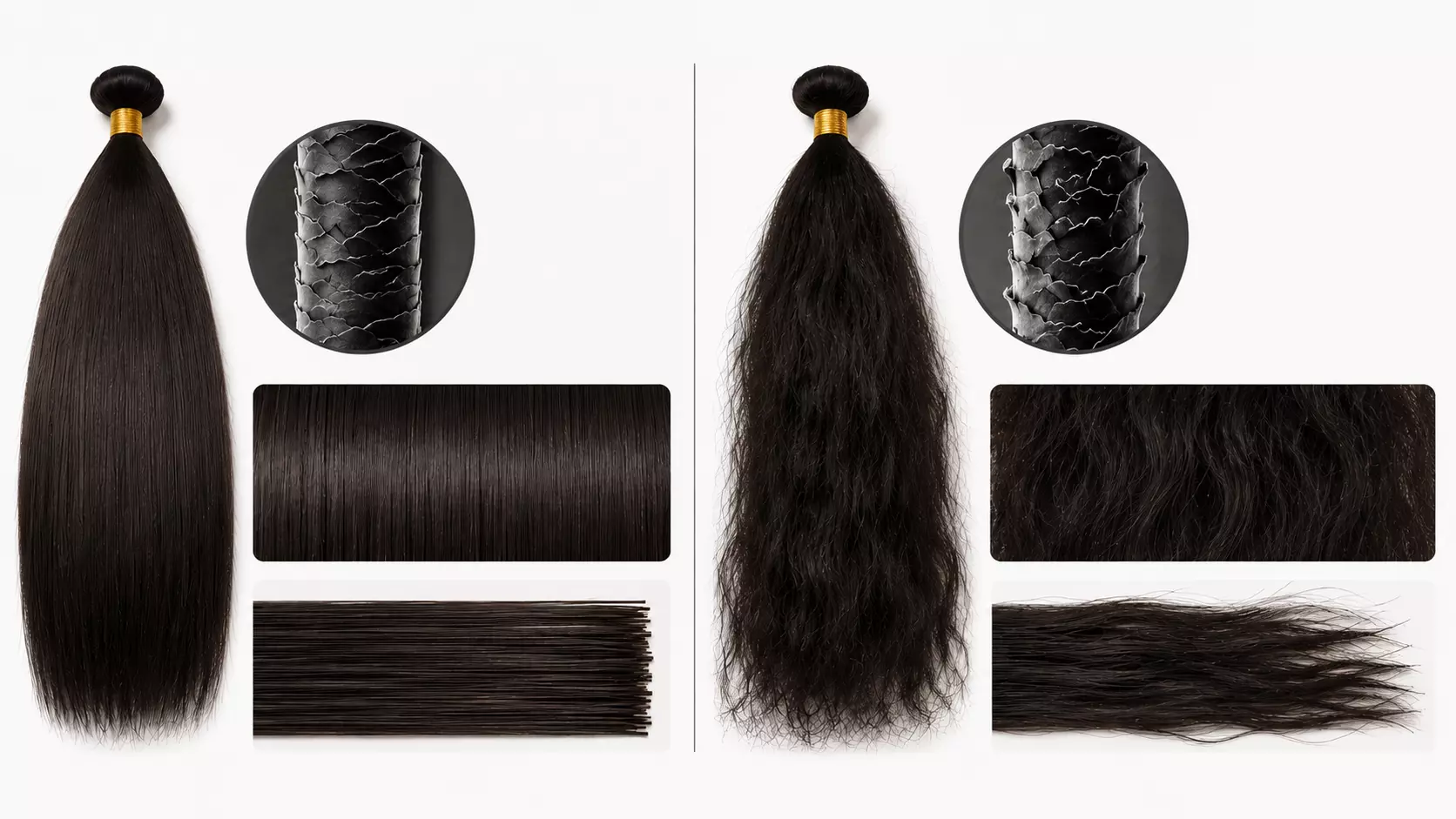
Research indicates that the fundamental difference between these hair types lies in the cuticle1. According to industry standards highlighted by sources like Indique Hair and Ellen Wille, “Remy hair is human hair that is collected from a single source or donor… the cuticles are unbroken and aligned in one direction,” whereas non-Remy hair often has stripped or misaligned cuticles, leading to a shorter lifespan . Understanding this distinction is critical for longevity.

What is the Real Difference?


If you have ever shopped for hair extensions or wigs, you have likely seen the term “Remy Hair” presented as the gold standard. But what does it actually mean? Is non-Remy hair a scam, or is it simply a budget-friendly alternative?

To put it simply, the difference between Remy hair and non-Remy hair is not about the origin of the hair (e.g., Indian vs. European) but strictly about how the hair is processed after it is cut. This single factor determines whether your investment lasts for a year or falls apart after one month.

Here is the definitive breakdown of how to tell them apart, how to spot fakes, and which one actually fits your lifestyle.
Remy Hair

How Is Remy Hair Defined?

When we talk about authentic Remy hair, we are referring to a specific grade of human hair where the cuticle—the outer protective layer of the hair strand—is kept completely intact. Furthermore, all the strands are arranged to flow in the same direction from root to tip .

Imagine a handful of drinking straws all facing the same direction; they slide past each other smoothly. That is how Remy hair works. Because the scales of the cuticle are all pointing the same way, there is no friction between the strands.

Key characteristics of authentic Remy hair include:

  • Tangle Resistance: Without misaligned cuticles rubbing against each other, matting is virtually eliminated.
  • Natural Shine: The intact cuticle reflects light just like your natural healthy hair.
  • Longevity: With proper care, these extensions can last between 12 to 18 months .

What is Non-Remy Hair?

Non-Remy hair represents the majority of the “cheap” human hair market. This hair is usually collected from various sources—such as hairbrushes, salon floors, or fallen hair strands—where the natural root-to-tip direction is lost .

Because the roots and tips are mixed up within the same bundle, the cuticles grate against each other. To fix this, manufacturers often take one of two routes:

  • 2Chemical Stripping: They dip the hair in acid baths to burn off the cuticles entirely. This leaves the hair smooth temporarily but weak and porous.
  • Silicone Coating: They coat the hair in heavy silicones to hide the damage. This creates an illusion of softness, but after 2-3 washes, the silicone washes off, revealing dry, tangled hair underneath .

The result? Non-Remy hair often becomes frizzy, mattes at the nape of the neck, and generally needs to be discarded after 1 to 3 months.

Comparison: Longevity, Cost & Styling

To help you visualize the user experience, here is a direct comparison of how these two types of hair behave in real life.

If you style your hair daily, the investment in Remy hair is almost always more economical. However, if you need a quick costume or a one-week style, non-Remy might suffice.

Remy Hair

Questions to Ask Before You Buy


To ensure you are paying for Remy hair and not a synthetic blend or low-grade mix, look for these red flags:

  • Is the price too low? Real human hair with intact cuticles is labor-intensive to produce. If a 20-inch bundle costs $30, it is chemically stripped non-Remy hair.
  • Does it feel “too slippery”? This indicates a heavy silicone coating used to mimic the feel of real Remy hair.
  • The “Bleach Test”: Place a strand in bleach. Remy hair (virgin) will lift color evenly. Non-Remy may turn orange or disintegrate due to prior acid processing.
Remy Hair

How to Maintain Your Investment


Once you have purchased high-quality Remy hair, maintenance is simple. Because the cuticles are intact, the hair behaves like your own.

  • Wash Gently: Unlike non-Remy hair that gets brittle, Remy hair retains moisture. Wash only 1-2 times per week.
  • Detangle Dry: Always brush from the bottom up with a loop brush to prevent stressing the knots.
  • Heat Protection: Even the best Remy hair can be damaged by high heat. Always use a thermal protectant.
Remy Hair

Frequently Asked Questions (FAQ)

A: Yes, Remy hair is 100% human hair. However, it is important to note that not all 100% human hair is Remy. The term “Remy” specifies the quality and alignment of the cuticles .

A: Because the cuticles (the tiny scales on the hair) are not aligned. In non-Remy hair, these scales rub against each other like Velcro, causing immediate friction, dryness, and severe matting .

A: Yes, generally. Because Remy hair has not had its protective cuticle stripped away by acids, it can safely handle hair dye. However, it is always recommended to do a strand test first .

A: With proper care, high-quality Remy hair extensions or wigs can last between 4 and 8 months. Some users can extend the life to 12 months depending on the frequency of wear and washing .

A: Not exactly. “Virgin” means the hair has never been dyed or permed. “Remy” refers to the cuticle alignment. The highest quality hair is Virgin Remy hair (undyed and aligned). However, hair can be non-Remy and still technically be virgin (undyed) if it hasn’t been chemically treated, though this is rare .

A: It is usually dipped in a silicone bath. This coating makes damaged, stripped hair feel smooth to the touch. Once you wash the non-Remy hair with shampoo, the silicone washes away, leaving behind the dull, tangled reality .

A: Minimally. Because the strands are aligned, friction is low. However, some minimal shedding at the weft (the seam) is normal for all hand-tied hair products. Excessive shedding usually indicates non-Remy hair or poor construction.

A: Most authentic Remy hair comes from single donors. However, it is up to the consumer to buy from vendors who verify their supply chain is free of coercion .

Conclusion

The choice between Remy and non-Remy hair ultimately depends on your budget and expectations. If you need a temporary solution for a single event, non-Remy can work. However, for seamless blending, consistent texture, and the ability to wash and wear hair for months on end, Remy hair is the clear winner.

By investing in Remy hair, you are paying for the meticulous labor required to keep the cuticles intact. You are buying hair that moves, shines, and breathes just like the hair growing from your scalp.

Note:

  1. The outer protective layer of a hair strand, made of overlapping scales; when intact and aligned, it reduces friction and provides shine and smoothness. ↩︎
  2. A process where hair is dipped in acid baths to burn off the cuticles, leaving the hair temporarily smooth but weak, porous, and prone to damage. ↩︎

About the author

Spread the word
Was this article helpful?
YesNo

Leave a Comment

Your email address will not be published. Required fields are marked *

Scroll to Top